

John Butler opened the taping by pointing at the tape. The trade-weighted dollar sits roughly where it did a year ago. Slightly below its three-year average. Above its ten-year average. Above its twenty-year average. And that is the puzzle he wanted to put on the table.
Because every mainstream school agrees on one thing. Neo-Keynesian, monetarist, even the Austrian school John belongs to. They all say a country that runs chronic twin deficits, budget and trade, should watch its currency weaken over time. The United States has run both for decades. The dollar has not weakened. John laid that contradiction down and turned to Brent.
The question for the episode was simple. Are recent shifts in U.S. fiscal, monetary, trade and currency policy undermining the dollar, its reserve status, and above all its value against gold?
Brent Johnson runs Santiago Capital and authored the Dollar Milkshake Theory, the argument that in a global liquidity drain the dollar pulls capital toward itself and rises against nearly everything. John Butler is a London macro writer, an Austrian by training, a former Lehman managing director, and a gold man who thinks the weaponization of the dollar is quietly corroding the thing that holds it up.

Why John Thinks the Dollar Is Eating Its Own Support
John builds his case on the plumbing, not the headlines. The dollar's strength never rested on being a good currency. It rested on structure. The petrodollar born in the wreckage of Bretton Woods, when Volcker and others cut the deal with the Gulf producers. The eurodollar system that exploded in the 1980s. The dollar as collateral behind the entire pyramid of global credit.
Every one of those supports, John argues, is now under strain. The Gulf arrangement looks shakier as U.S. objectives in the region stall. Sanctions stacked on sanctions push France, Russia, China and others to find ways around the dollar so they can trade how they want. And European central banks are quietly repatriating their gold from New York and London vaults. That is not a vote of confidence. That is a trust breakdown, and John says trust is the whole game.
Then there is the raw economics. The U.S. remains dependent on foreign capital, and foreign holders are sitting on net creditor positions. If they look for a real asset that no state can default on or devalue, they land on gold. John sees that as structurally positive for gold regardless of real rates, regardless of the news cycle. He will even grant the dollar may hold against other fiat. But against gold, he does not see how the math breaks his way.
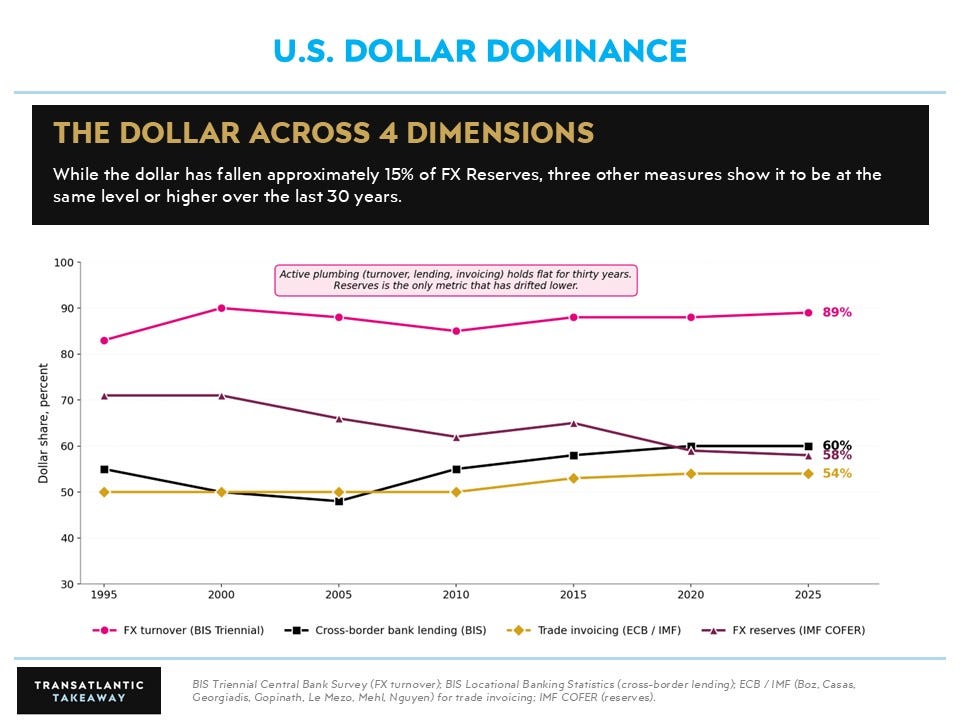
The tension John leaves hanging is this. The dollar can look fine on four measures and still be rotting on the one that matters most for the long game.
Why Brent Thinks the Squeeze Comes First
Brent does not fight the history. He extends it. The dollar was backed by gold, then backed by oil, and now, he says, it is backed by debt that was taken out because it used to be backed by oil. Demand for dollars outside U.S. borders runs greater than demand inside them. That single fact, he argues, is why hyperinflation is off the table and why the whole system has outlasted every obituary.
The heart of Brent's case is the eurodollar monster. Dollars are not printed. They are loaned into existence, by the Fed, by the Treasury, by everyone in the offshore market. Which means the debt is enormous, hidden, and self-reinforcing. He put up the BIS off-balance-sheet number. Four years ago it read 85 trillion dollars. Now it runs close to 115 trillion. A jump of roughly 30% in four years, most of it owed by entities outside the United States.
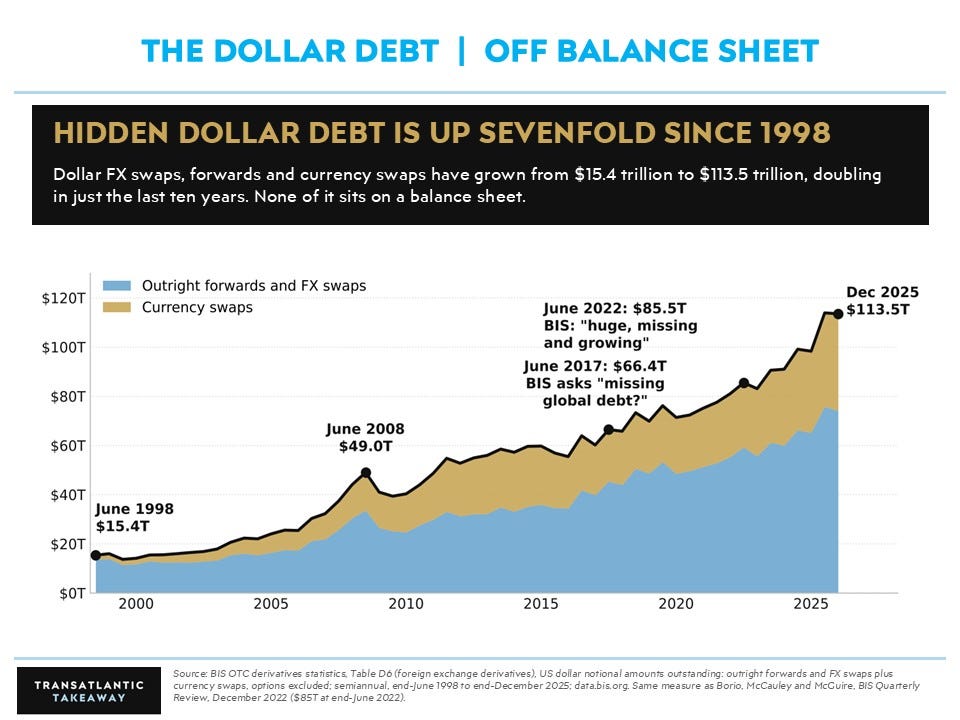
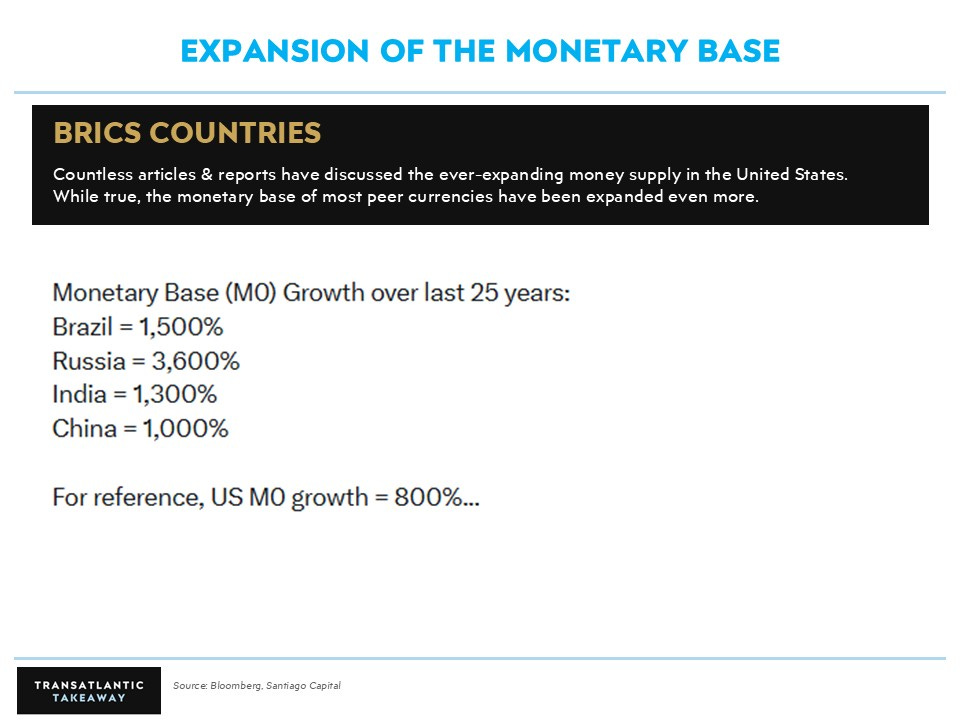
Here is Brent's mechanism. A debt-based system has to keep expanding or it chokes. When credit contracts, the borrowers scramble for the one thing they cannot print, the dollars to service dollars. That is a short squeeze. That is why the dollar ran from 89 to 113 in 2022 as COVID-era credit came due. And John's own point, that peer currencies have inflated even harder, cuts the same way. Brazil's monetary base up 1,500%, Russia 3,600%, against U.S. M0 up 800%.
Brent frames the Fed swap lines as the one ring that binds them all. The power of Sauron, seductive, abusable, and still decisive in a crisis. His verdict on John's thesis is not no. It is not yet.
The Point Where Both Men Cannot Be Right
The clash lands on one exchange. John asks what happens if Japan and the rest of the world repatriate capital and dump their Treasuries. Clean up the global balance sheet, rebalance, close the gap.
Brent's answer is blunt. The dollar skyrockets.
That is the fault line. John sees net creditors selling U.S. assets and the dollar sinking under the weight. Brent sees the same sellers forced to find dollars to retire dollar debt that does not reprice. In a liquidation, assets fall, principal owed does not. So the sale that is supposed to sink the dollar instead starves the system of the very dollars everyone owes. Price up, not down.
Both cannot be true. Either the dumping of U.S. assets weakens the dollar, as every conventional framework predicts, or the dollar debt underneath it forces a squeeze that sends it the other way. The 35 trillion of U.S. assets foreigners hold against the 115 trillion they owe is the number the whole disagreement turns on.
Where It Moved and Where Neither Man Budged
This is where the honest part shows. Brent gave ground on gold, openly. He has no problem with a higher gold price, and he agreed John's structural case against the dollar holds against gold, around the margins. He granted the Swiss franc could rip in a true crisis. He conceded the U.S. is starting to overuse the gift, and noted, with John supplying the German, that Gift means poison.
John gave ground too. He accepted the dollar's extraordinary structural advantages, accepted it could crush its fiat peers in a seizure, and took Brent's sharpest point to heart. The path dependency of returns. You can be right about the endgame and still get knocked out before it arrives, like a knockout option that expires worthless the instant the barrier is touched. John called that the heart of any robust process, and the humility to admit you do not know the path.
Where neither moved was timing and sequence. John thinks the supports are eroding now. Brent thinks the hegemon does not roll over, that the squeeze comes before the fall, and that people want to reach the end of the movie too soon. His steroid metaphor held the line. Weaponizing the dollar makes the athlete stronger in the short run and kills him in the long run. The question is only how long the short run lasts.
So you are left with the question you walked in with. Are U.S. policy shifts undermining the dollar against gold? Both men say yes, eventually. Neither can tell you whether the dollar soars or sinks on the way there. And that gap, between the endgame and the path, is the whole trade.
TransAtlantic TakeAway is a free weekly debate between Brent Johnson and John Butler on the forces moving markets. Subscribe to get every episode.

