Japanese Dis-Saving: Will It Crack Global Stock Valuations?
Brent and John agree Japan’s savers are turning the global cost of capital higher. They split on who it breaks, and whether Tokyo ever drifts toward Beijing.

A few weeks ago, the United States Treasury did something it had not done in years. It joined Japan in a joint intervention to prop up the yen, which had slumped to its weakest level against the dollar in a long time. Interventions happen. Japan steps in from time to time. What made this one unusual was the partner. And the method was stranger still. Washington sold euros to buy yen, not dollars. Read that twice.
So here is the question the episode put to the two men. Are the world's greatest savers, the Japanese, beginning to structurally dis-save, and if they are, where does the pain land?
John Butler, writing from London, starts from the supply side. Japan is a margin business. It imports energy, exports manufactured goods, and keeps the spread. The Gulf shock squeezed that spread, the yen weakened, and the question is whether a demographic and energy story has flipped Japan from the world's capital supplier into a net drain.
Brent Johnson, of Santiago Capital, starts from the plumbing. He does not dispute the setup. He disputes the destination. Same facts, different conclusion. That is the whole show.

Why John Butler Thinks Europe Breaks First
John's case runs on the Eurodollar system and on one chart that genuinely stops you. Japanese ten-year yields are roughly five times what they were a couple of years ago. When the price of Japanese money rises, the world's largest pool of exported savings gets more expensive for everyone who has been borrowing it. That is a global cost-of-capital event, not a Tokyo event.
The transmission is already visible, and John points west to prove it. A major Japanese asset manager, Sumitomo Mitsui, sold out of its entire French government bond holding this month. Look at what French yields have done against Germany. The spread between France and Germany has blown out to roughly 1.5%. For most of the monetary union's history that gap lived in the single or low double-digit basis points. Now France pays a punishing premium to borrow, and at that premium France stops being competitive.
Here is the structural logic, stated plainly. If the discount rate goes up, valuation multiples have to come down. That is arithmetic, not opinion. A higher global cost of capital pressures stock markets everywhere and tortures heavily indebted governments first. And when the squeeze comes, it is the marginal borrower who gets taken out. In Europe, John argues, that is not Germany. Germany is the anchor, with a lower debt-to-GDP ratio and a price-stability tradition. The marginal borrower is France, with the bigger bond market and the heavier debt load. So the vigilantes pounce on France. Sumitomo did the math and left. The tension John leaves on the table is uncomfortable for the whole continent. Europe is the preferential exposure, the one nobody is forced to hold.
Why Brent Johnson Thinks the US Is the Last Thing Standing
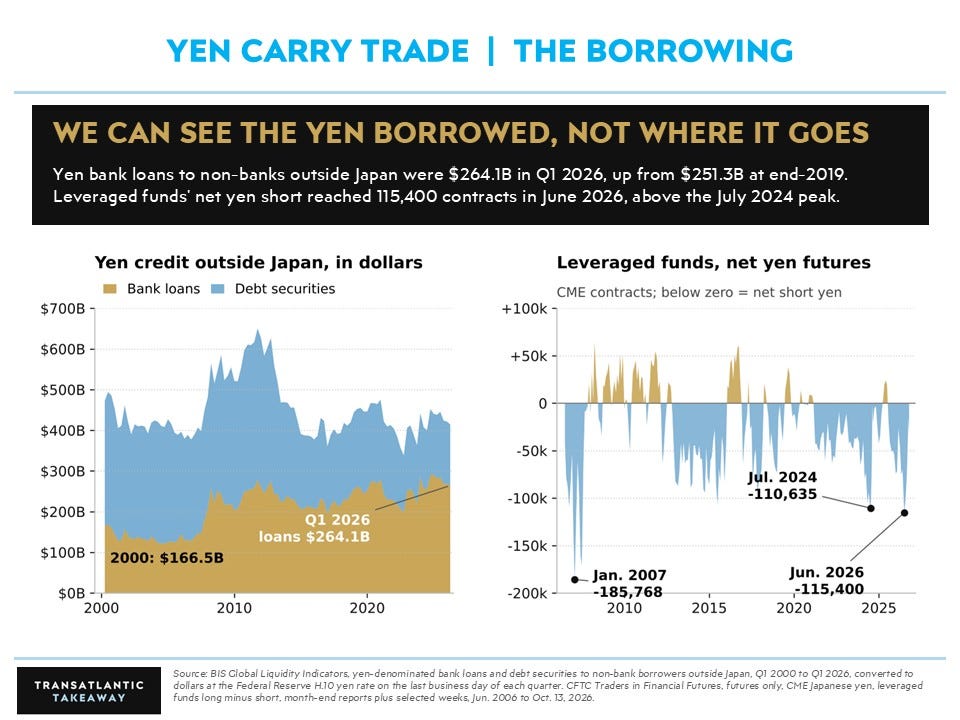
Brent agrees it is an issue. He agrees it is underappreciated. Then he turns to the carry trade and the Dollar Milkshake logic that organizes everything he sees. Borrow in yen at near zero, invest abroad at a higher yield, lever it up, clip the coupon. It worked for decades because Japanese rates stayed on the floor. Leveraged funds' net yen short hit 115,400 contracts in June, above the July 2024 peak. Positioning is enormous, and enormous positioning moves hard when it moves.
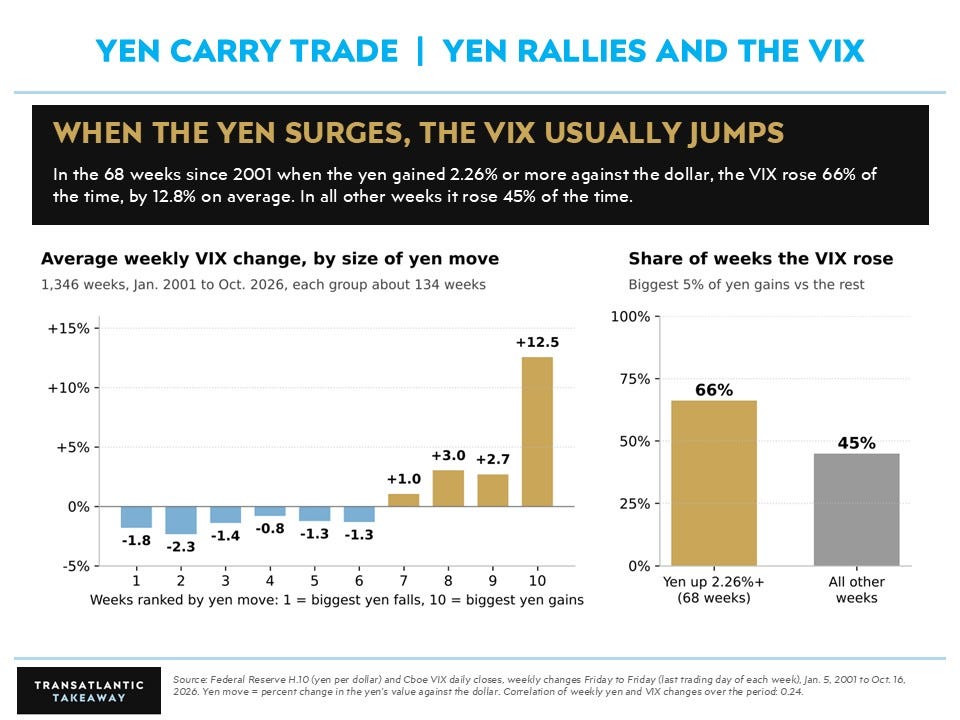
The direction of the move matters more than the move itself. Brent's evidence is the asymmetry. When the yen weakens, nothing happens, and everyone relaxes. When the yen rallies 2% or more, the VIX jumps.
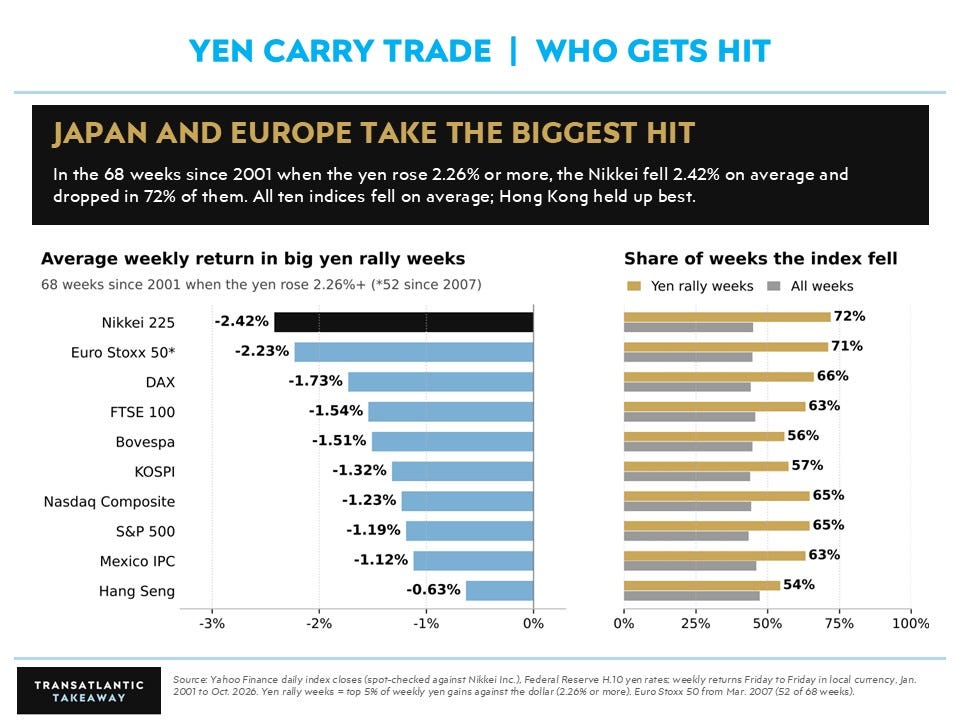
And when that unwind hits, the money floods back to Tokyo to close the trade. That is positive liquidity for Japan and negative liquidity for wherever it was parked. So which market gets hit? Brent's data says the Nikkei falls hardest, with Europe second. His read on why is the Eurodollar read. Treasuries are still collateral everywhere. Nobody gets fired for owning them. Europe is preferential, the US is plumbing.
That is why he keeps coming back to the poker table. The US is the big stack with the ability to print more chips. Rising yields are the blinds going up. Higher antes knock out the short stacks first. An 8% ten-year Treasury would be ugly for America, and Brent concedes that openly, but if the US genuinely cannot raise money, that is the mother of all sovereign debt crises and everyone's cost of capital is already higher. He is not telling you it is good. He is telling you it is last.
Where the Two Cases Cannot Both Be Right
Both men agree Japan is less leveraged than it looks. Add the private savings pool to the government debt and the net picture is less stretched than the United States. John presses that into a conclusion: relative is the word. If multiples crack globally, US multiples fall more than cheap Japanese basic-industry multiples. Japan holds up relatively well, cushioned by the largest net foreign asset pile on earth.
Brent will not follow him there past the first move. In the initial sell-off, he argues, the Nikkei does worst of all, down more than the S&P, because the repatriation flow slams Japan on the way home. Coming out the other side, after the central-bank reaction, he grants that John may be right that Japan recovers well. That is the exact seam. John says Japan is the relative winner through the storm. Brent says Japan is the worst casualty into the storm and maybe a winner out of it. They cannot both own the whole path.
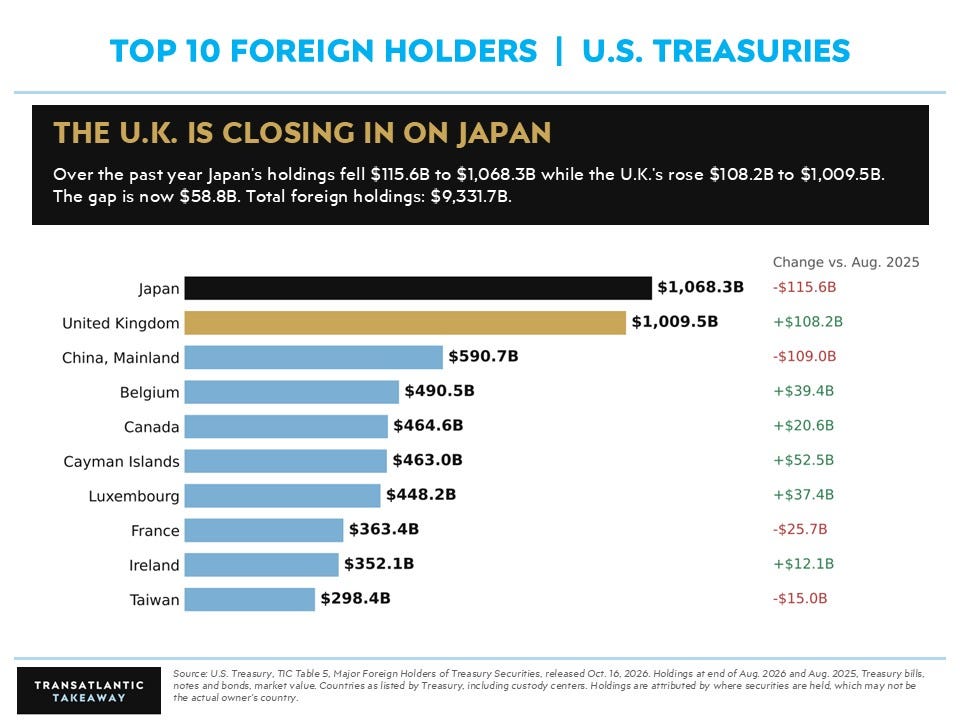
And they cannot both be right about Japan's Treasury pile. Japan is still the largest foreign holder, and over half its foreign securities sit in the US, with around 18% in the Cayman Islands. John reads the euro-not-dollar intervention as a signal: Europe is, he hates the word, expendable, and Washington protected its own bond market. Brent reads it the same way and adds a second layer. If Japan is forced to sell Treasuries to fund its needs, yields stay higher for longer, and that pressure radiates everywhere.
Where It Moved and Where Neither Man Gave an Inch
This is where John threw the curveball, and Brent admitted he did not see it coming. Running on Realpolitik, John told the story of Eisuke Sakakibara, Mr. Yen himself, who told a Chinese audience years ago that Japan is an Asian country and its future lies to the west, not the east. John's argument: not all at once, but across decades, the natural geo-economic pull is for Japan to move closer to China. Energy has to come from somewhere, and if the US Navy can no longer guarantee it, Tokyo looks elsewhere.
Brent did not fold, and he did not dismiss it. He put the probability very low and said so plainly, citing the historical scar tissue between the two countries. But he did the honest thing a good debater does with a low-probability idea. He asked what would have to be true. His answer: a grand bargain carving the globe into three spheres, with the US ceding the Pacific, and Japan left with no other choice. He conceded he had to think about it more. Neither man moved off his core. One case needs Japan to hold the center. The other needs it to drift. The charts cannot settle that one.
So return to the question on the title card. Are Japan's savers beginning to structurally dis-save, and if so, who pays? John says the world's cost of capital has already turned and Europe's marginal borrower pays first. Brent says the short stacks clear the table before the big stack ever feels it. Both men are reading the same yen, the same yields, the same intervention. Nobody knows what a world of Japanese dis-saving looks like, because there has never been one.
TransAtlantic TakeAway is a free weekly debate between Brent Johnson and John Butler on the forces moving markets. Subscribe to get every episode.
Discussion about this video