Defensive Hoard vs Monetary Endgame: The Central Bank Gold Fight
Central banks keep stacking gold while still buying Treasuries. Brent sees insurance. John sees a monetary endgame. Which train is this?

In September, the Dutch National Bank moved a large slice of its gold out of New York and Canada and into London. The stated reason was simple. London felt like a more neutral jurisdiction if the bank ever actually needed to use the metal. Germany had done something similar in 2017, hauling a substantial amount home from New York. These are not rumors on a forum. These are central banks physically relocating their gold, and they are doing it at the same time the pace of official gold buying has accelerated since the 2008 crisis and again since 2014.
That is the backdrop. And it leaves one plain question on the table.
Why are central banks still accumulating gold when gold has not been official national money anywhere on Earth for decades?
John Butler starts where a reader of his book would expect him to start. He sees a train of reasons, each car hooked to the next, and he can see where the train is headed. Gold as store of value, then gold as insurance, then gold mobilized, then gold remonetized. John thinks the world is further down that track than most people admit.
Brent Johnson starts from the same data and refuses to board the train. He sees gold as defense, not offense. Insurance you hold and hope you never cash. He agrees de-dollarization is real at the margins. He just does not think it is the sea change the charts seem to scream.

Why John Butler Reads This As a Monetary Endgame
John builds it brick by brick. Central banks hold reserves. Treasury supply has grown for decades, both outright and against GDP, so there is no shortage of dollar collateral to accumulate. And yet foreign demand for that collateral has leveled off while gold's share has climbed to meet it.
John's point is that gold's share of global central bank reserves has caught up to Treasuries, roughly 24% gold against 21% Treasuries, a line that crossed after sitting far apart for years. The Fed published a paper in September downplaying that crossover as arbitrary. John wrote back, titled it "The Fed Doth Protest Too Much, Methinks," and argued their case reduces to semantics and weak logic.
Then he brings the evidence that central banks mean it. Over the past year they added roughly 42 tons at a much higher price, almost the same tonnage as the year before. Jewelry demand fell hard, because households are price sensitive. Central banks are not. They treat gold as strategic, not as something to trade for a few dollars.
And then Russia, his live example. Sanctioned, fighting an expensive war, Russia liquidated about 62 tons this year, the largest drawdown since the 1998 ruble crisis. John calls that gold used offensively. You cannot raise taxes fast enough to fund a war. Napoleon paid his soldiers in silver and gold to the very end. Russia is mobilizing the hoard for exactly that reason, and John believes other countries, pushed by a multipolar world full of simmering conflict, eventually build the plumbing to do the same. The friction is real. Jurisdiction, custody, transport. But where there is a will, there is a way.
Why Brent Johnson Still Calls It a Defensive Hoard
Brent agrees with almost all of it. That is what makes the fight worth watching. He just disagrees on scale and consequence.
His first move is to zoom out. Yes, Treasuries as a share of reserves fell. But look at absolute foreign holdings of U.S. Treasuries. They have never been higher than today.
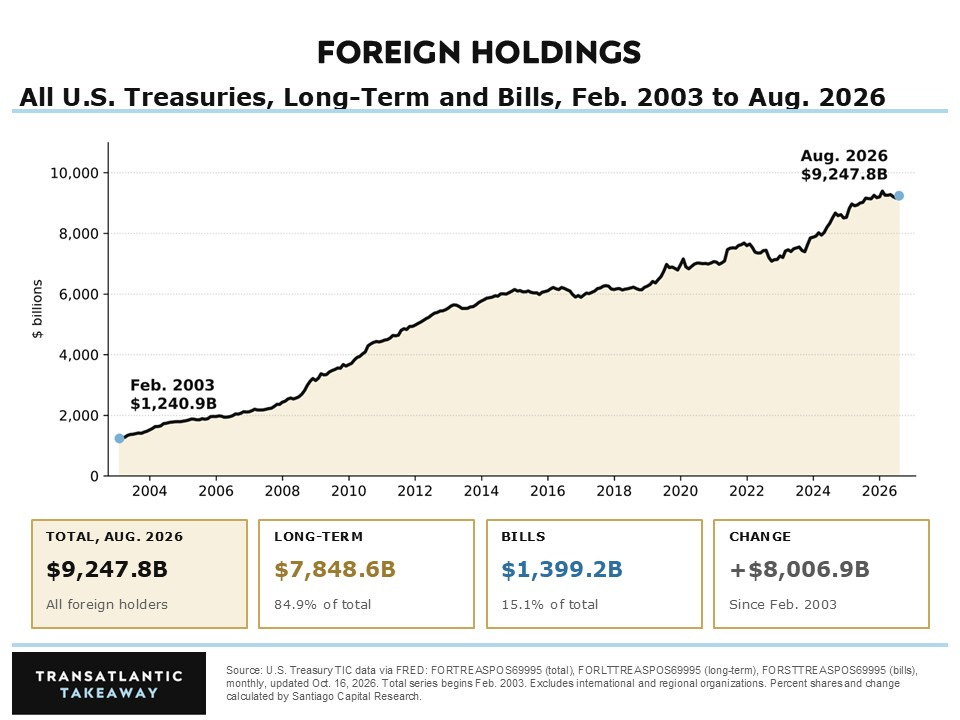
Foreign holders sat near $1.2 trillion in 2003 and now hold over $9.2 trillion. That is not a boycott. That is a mountain still being climbed.
Then Brent makes the point he thinks half the audience misses. Those gold-up, Treasuries-down share charts are current market value charts. Gold tripled in five years. Bond prices fell anywhere from 10% to 30%, depending on maturity. Move the share purely on price and the units barely moved at all.
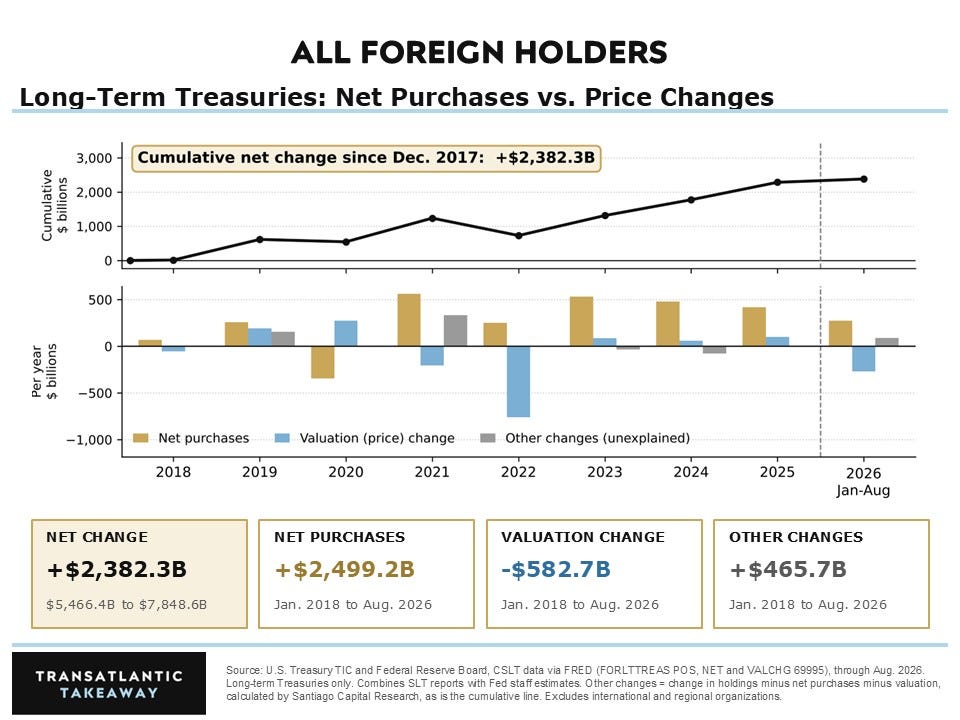
Strip out valuation and the cumulative net change since 2017 is a positive $2.4 trillion of actual buying by all foreign holders. The blue valuation bars yank the share around. The gold bars show people kept buying bonds.
Brent concedes the official sector is the real story, and China most of all, with net sales near $600 billion. But watch what happens on the other side of the ledger. Canada started buying Treasuries dramatically at the very moment China sold. Belgium and the Cayman Islands show the same suspicious "other changes." Brent met with the Treasury group that builds these reports. By law they cannot identify a single institution, so official flows stay murky. His takeaway is blunt. Even if China dumps en masse, somebody is buying en masse. The impact is smaller than the China headline suggests.
The Point Where Both Men Cannot Be Right
Here is the exact spot where the two cases cannot both hold.
John says gold mobilized to serve the national interest is offense, and that once distrust in the system grows, game theory forces a neutral venue into existence. It is nonlinear. There are decades where nothing happens and weeks where decades happen.
Brent says to use gold you have to sell it. You do not get weapons and keep the metal. Cash the insurance policy and the gold is gone. And then the structural catch. The plumbing John needs requires a neutral site to settle and transfer, and Brent asks the killer question. What site? Nobody ships their gold to China and calls it neutral. Nobody trusts Russia or South America. The most neutral vault, despite everything the U.S. has done to weaponize its power, is still New York. Maybe Switzerland. That is the list.
Brent's sharpest line is that Russia is an outlier with no twin. Biggest country, most resources, strong military, nuclear, strong leader. Ethiopia cannot do what Russia does. Argentina cannot. He does not deny the example. He denies that it scales.
Where It Moved and Where It Did Not
Both men gave ground, and both held their core.
John conceded the friction fully. Jurisdiction, custody, transport, and the path dependency of reserves. He agreed that in a liquidity squeeze gold moves from weaker leveraged hands to stronger ones, that gold can fall hard relative to Treasuries, as it did in 2008, and that anyone who reads the share chart as a straight line to zero Treasuries is drawing the wrong conclusion. He also agreed the time horizon for any remonetization is longer than he might like.
Brent conceded the offense is real when he admitted that furthering the national interest by mobilizing gold is, by John's definition, offense. He conceded fiat is a poor long-term store of value and that central bankers know it. He even brought the Dutch central banker's own words to John's side, the admission that gold exists to rebuild confidence if the currency goes badly wrong.
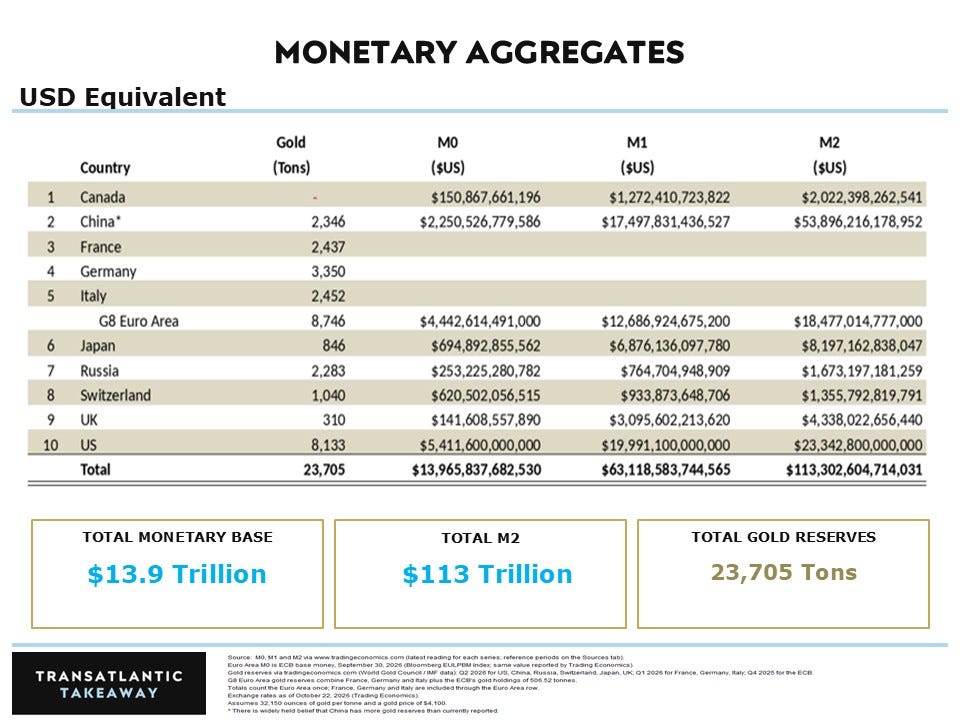
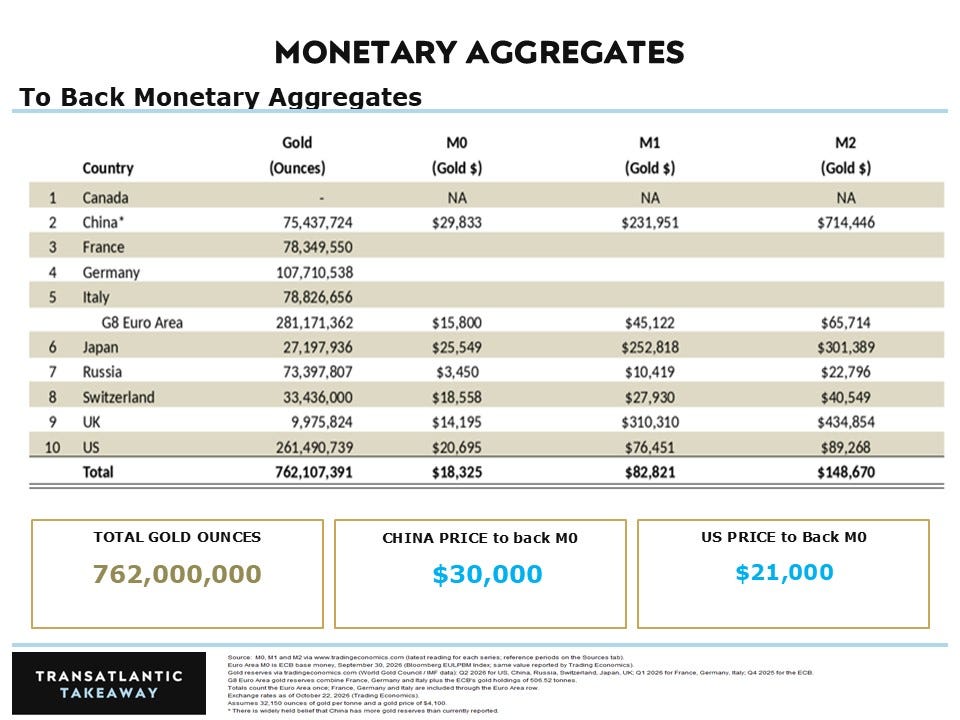
Where neither moved was consequence. John still believes the train arrives. Brent still believes it stalls on logistics. They watched the same monetary base math, where backing U.S. M0 would need gold near $21,000 and China near $30,000, and even M2 at $90,000 for the U.S. against over $700,000 for China, and each read it as proof of his own thesis.
So the question stays open, the way the show likes it. Central banks are hoarding gold and still buying Treasuries, and nobody on this episode pretended to know the year the two trends collide. John hears a clock ticking toward remonetization. Brent hears an insurance policy nobody wants to cash.
What is not known is which man is early and which is wrong, and whether the difference is a decade or a single week.
TransAtlantic TakeAway is a free weekly debate between Brent Johnson and John Butler on the forces moving markets. Subscribe to get every episode.
Discussion about this video