

It started at Munich. Two years ago, Vice President Vance walked into the Munich Security Conference and scolded the room. This year, Secretary of State Rubio walked in softer and said something sharper. We came from you. We will always be intertwined with you. But the United States has no desire to cooperate in the managed decline of the West.
Read that line twice. It is a door closing gently.
That is where this episode of TransAtlantic TakeAway begins, because the Munich speeches put a question on the table that nobody could have asked seriously twenty years ago.
Is the transatlantic relationship actually in danger of breaking down? The alliance. The special relationship with Britain. And if it breaks, what does that do to markets?
John Butler is an American who has lived in Europe for thirty years. Germany in 1995, London since 2001. Four kids raised on that side of the water. He starts from a view that Europe is in more danger than the United States, but that the danger could force a reform process so deep it ends in a European renaissance worth owning.
Brent Johnson starts from the Dollar Milkshake. He agrees Europe is broke and cornered. He just thinks the cornering runs one direction, toward Washington, not away from it. He sees this driven by power and position, not preference or trade.

How John Butler Says Europe Dug Its Own Grave
John does not blame Washington for Europe's fix. He blames Europe.
Here is his chain. After the Cold War, Europe played a free rider game. It kept the U.S. security umbrella while cozying up to Russia for cheap gas. Nord Stream was the crowning achievement of that integration. Then Nord Stream got blown up, and the free ride ended.
But the self-harm started earlier. Europe marched down the net zero road while still burning Russian gas. It closed roughly 20 oil refineries. Germany decommissioned its nuclear plants and built no new ones, betting wind and solar would fill the gap. Spain, which gets far more sun than Germany, saw its overdependence on solar help trigger a nationwide blackout that stopped the trains and the elevators for hours.
All of this while funding generous welfare states for aging populations that also carry double digit youth unemployment.
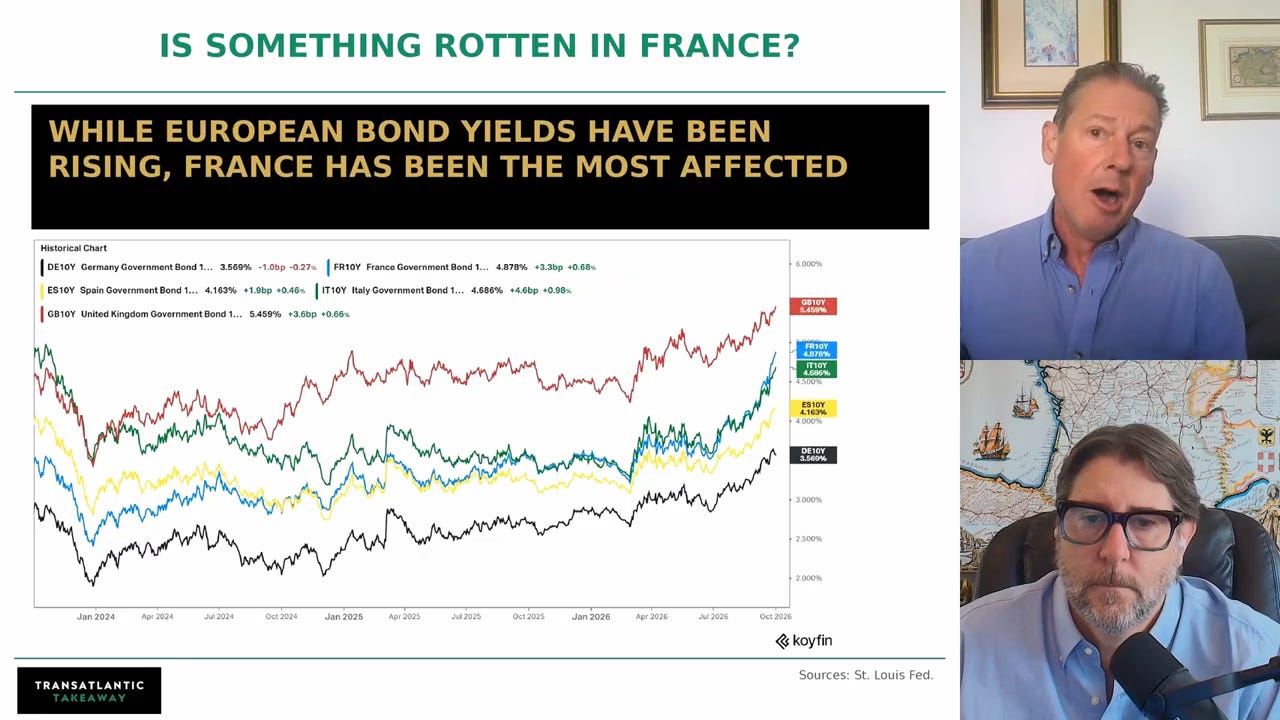
Then John points at France. Once a high quality euro sovereign, now one of the lowest quality credits in the bloc. A big country, nuclear arsenal, facing a populist uprising and a possible anti-EU government.
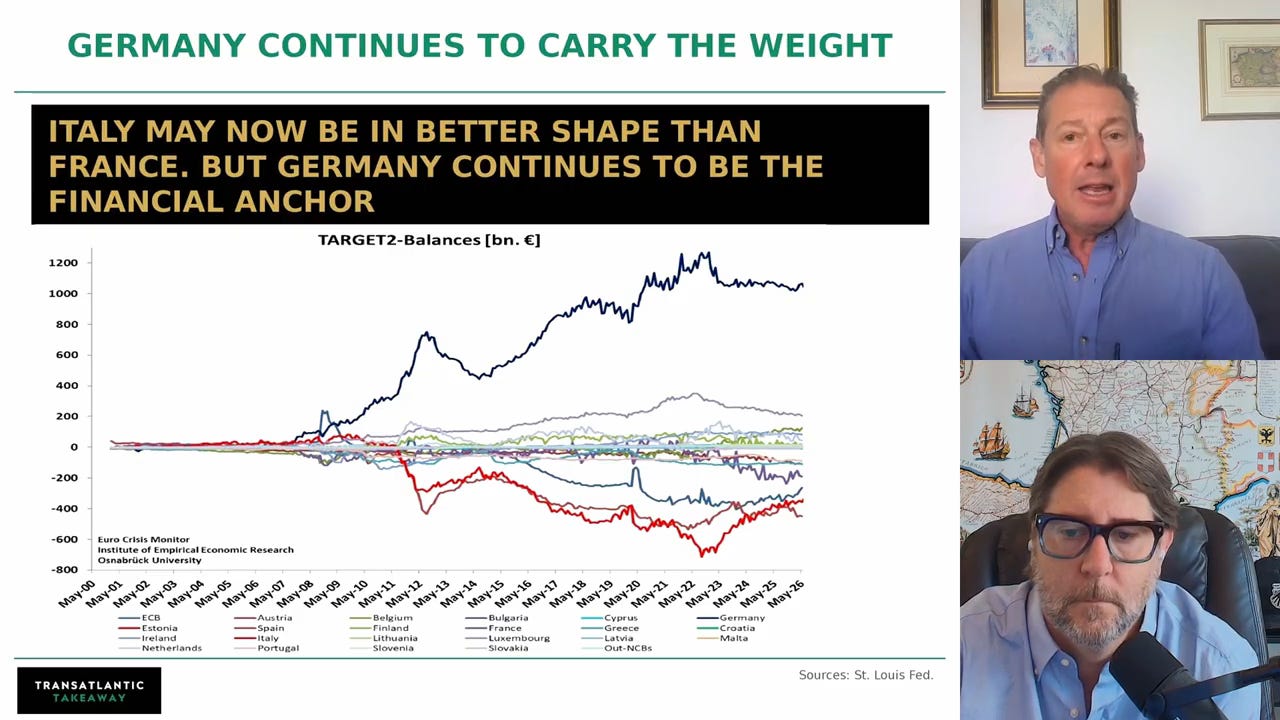
And Germany, the engine, has had no jobs growth since 2018. Eight years. The sick man again, because the cheap energy is gone. That is the fix John describes. Broke, angry, out of energy, and the chickens coming home to roost.
Why Brent Thinks Europe Gets Pulled Toward Washington, Not Away
Brent agrees with almost all of it. Everyone has problems. Europe just has more of them, and more that are self-inflicted. The disagreement is about where the gravity pulls.
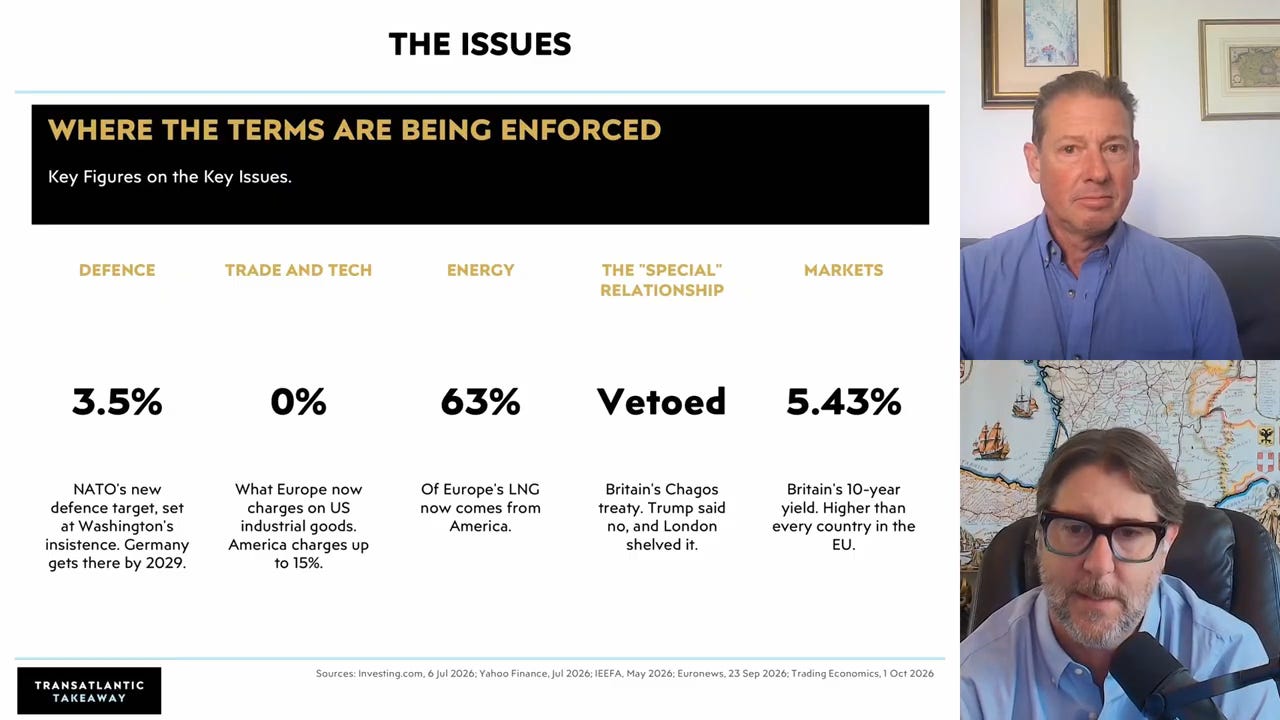
Brent frames it as five or six pressure points. Defense. Trade and technology. Energy. The special relationship. And he reads them through power, not economics.
Defense is the vise. To stay in NATO's good graces, Europe has to spend far more, and the bond yields John just showed make that brutal. Financial repression, mandates, or raiding the welfare states already built. There is no comfortable money.
Energy is the biggest lever, and Brent says it points at America. Europe now gets 63% of its LNG from the United States. In any conflict between the two, that single number tells you who holds the short term upper hand.
Then Brent adds the part people underrate. Washington telling allies how to run their own foreign policy, and getting away with it. Look at the Chagos Islands and Diego Garcia. The UK was going to hand the deal to Mauritius. Trump said no. The payments got halted. The U.S. effectively vetoed a British decision.
That is the special relationship under strain, but still intact. Still bending the UK toward America. Brent's read is that this is where a dollar system goes to feed. Europe strains, the euro weakens, the dollar rises on a relative basis, and a rising dollar pops problems that were not even visible before.
The Exact Point Where Brent and John Cannot Both Be Right
Here is the hinge. John's renaissance requires Germany and its eastern bloc to turn the cheap energy back on. That means rapprochement with Russia.
Brent says that is the weak link. He will grant you Germany rising from the ashes. He will grant you Poland, which in purchasing power terms now passes Britain and France per head. What he will not easily grant is Germany and Poland cozying up to Russia while Russia remains outside the dollar system and at odds with the United States.
John answers with two words. Nuclear weapons. If Germany and Poland decide they no longer need the American umbrella, the whole calculation shifts. Poland has already hinted. Germany could go nuclear in months if it chose. Remove the security dependence and the appetite for American approval drops. A little financial punishment from Washington becomes a tradeoff worth making for cheap energy on your doorstep.
Brent is unconvinced that Poland wants it. The history between Poland, Germany and Russia is not warm, and it does not soften on a spreadsheet.
That is the clash. John says geoeconomics eventually trumps geopolitics, because cheap energy on your border beats expensive energy half a world away, and that tips the whole thing east. Brent says the long established relationship plus an angry United States keeps Europe tethered west. Both cannot be true. Either the pipeline politics pull Germany back toward Moscow, or the dollar and the alliance hold the line.
Where It Moved and Where Nobody Budged
On the short term, there was no fight. Both men agree Europe is in serious trouble. The euro weak. Sterling caught in the same mess, maybe headed to the IMF. The dollar the place capital runs. And John adds gold, which Brent takes without argument.
Brent gave real ground at the end. His closing takeaway was not that John is right. It was that low probability does not mean zero probability, and low probability events carry outsized effects. He admitted plainly that a transatlantic breakup is something he is not prepared for, and that figuring it out mid-chaos is the worst place to start. Be prepared for everything rather than predict it.
John gave ground too. He conceded Brent was right to raise the possibility that the United States actively exploits Europe's weakness, deepening the energy and trade and defense dependence rather than letting Europe drift. He admitted he wavers into the geoeconomics camp a lot, which is honest, because it means he knows the other camp exists.
Nobody moved on the hinge. The question of whether Germany turns east stayed exactly where it started. Unresolved, and admittedly unknowable.
The Question You Are Left Holding
So the door at Munich closed gently. The United States will not help manage the decline of the West. That leaves Europe to choose its direction under strain, and the two men cannot agree which way the current runs.
Brent sees the gravity of the dollar and the weight of an old alliance holding Europe west, even through pain. John sees cheap energy on the doorstep eventually bending Germany and its eastern neighbors east, pain and all.
What is actually unknown is the thing neither man pretended to know. Whether a continent in a fix reaches for the relationship it has, or the energy it lost.
Pipelines have a way of deciding these things long after the speeches are over.
TransAtlantic TakeAway is a free weekly debate between Brent Johnson and John Butler on the forces moving markets. Subscribe to get every episode.

