Is Iran the Suez Moment That Ends US Hegemony?
John reads the Iran war as the end of US hegemony. Brent reads it as a messy mid-game. Same facts, opposite verdicts, and no winner.

The bombs started falling on Iran earlier this year. The opening strike reportedly killed Ali Khamenei in his Tehran compound. Over the weeks that followed, the chief of the general staff went, the defense minister went, the IRGC commander went. Iran's own count reached 3,468 dead by April 18. Then Iran counterstruck. The Yemenis entered the war and hit airports in Saudi Arabia. The US pulled its ships and its land forces back and set a perimeter much farther out.
Six months later, Brent Johnson and John Butler sat down to argue about what it meant.
The question was one line. Are the United States operations in Iran this year the Suez moment that ends US hegemony?
John Butler is a London macro writer who thinks in long historical arcs and reads the world through the lens of sea power versus land power. He starts from the view that American hegemony has been declining for years, and that this war is the proof. Brent Johnson of Santiago Capital, the man behind the Dollar Milkshake, starts somewhere colder. He does not deny the costs. He denies that it is time to call the game.
So who is reading the evidence right? Start with the man who says the game is already over.

Why John Butler Sees Suez in the Gulf
John walks you through Suez first, because the analogy is the argument. In 1956 Britain and France, still victors of the war but much weaker than they knew, moved with Israel to seize back the canal from Nasser. They did not tell Eisenhower. Eisenhower picked up the phone and told the prime ministers to stop or lose all US support. They backed down. That was the day two empires learned they no longer set the terms in the Middle East.
John's case is that Iran is that same lesson for Washington. Define the battlefield, he says. The battlefield is Iran itself. Iran did not attack its neighbors. Once attacked, it counterstruck, and the US retreated from the battlefield. Now it tries to fight in other dimensions, through sanctions that have been in place for decades already. He stacks the straws on the camel. Afghanistan. Iraq. Yemen. A long run of wars that bought a few decades of time and little else. Britain won its Afghan wars outright and still lost India by the late 1940s.
Then he lands the hard point. This one is different because boots on the ground are off the table. The Pentagon knows it. Every serving member of the US military, placed into Iran, would still be a thinner presence than the US ran in Vietnam at its peak. That is the scale of the country. And public opinion is already lost, in five or six months rather than five or six years.
John's deepest claim is the asymmetry. The US is the imperial sea power. It needs blood, treasure, and public opinion to keep ventures abroad alive. Iran is a land power at home. It needs only to survive. That is not symmetric, and the US carries the heavier burden.
So what, exactly, can Iran not get back? That is where John rests his case.
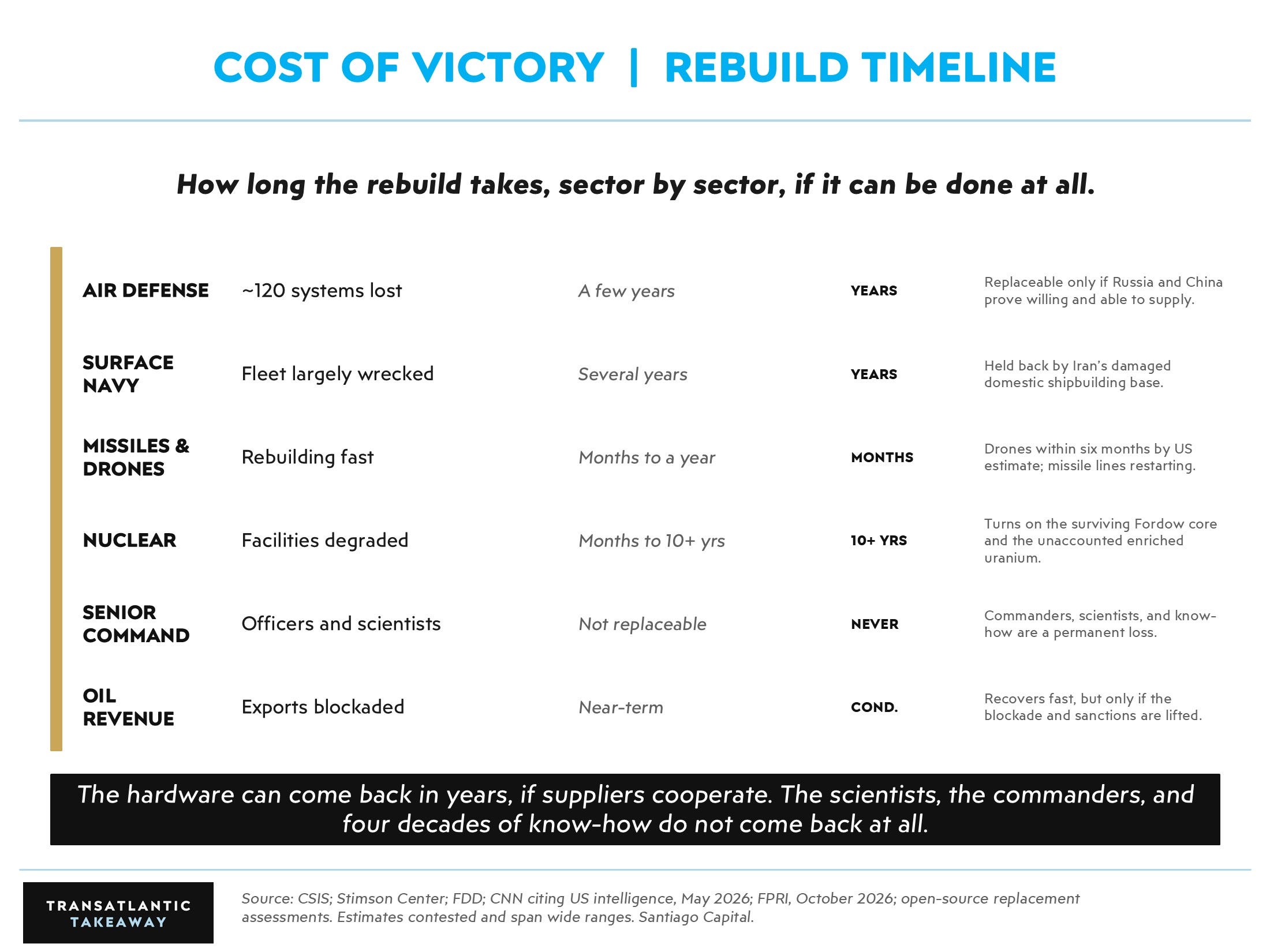
Caption: John's whole case rests on what cannot be rebuilt. The hardware returns in years. The commanders, the scientists, and four decades of know-how do not. Alt: A sector-by-sector rebuild timeline showing air defense and navy in years, missiles and drones in months, nuclear up to ten-plus years, senior command marked never, oil revenue conditional.
Why Brent Johnson Thinks It Is Too Early to Call
Brent concedes the frame. He calls Suez a good analogy and says you cannot remove the end-of-hegemony outcome from the table. Then he presses on the evidence, because for Brent the analogy is not the proof.
His first move is to challenge what "a win" means. If Iran is merely surviving in its current state, not exporting oil, infrastructure damaged to the tune of a couple hundred billion, social unrest at home, how is that a win and not simply the absence of total defeat? He points at the oil. Gulf producers routed around Hormuz and came back to prewar volumes. The blockade now falls almost entirely on Iran.
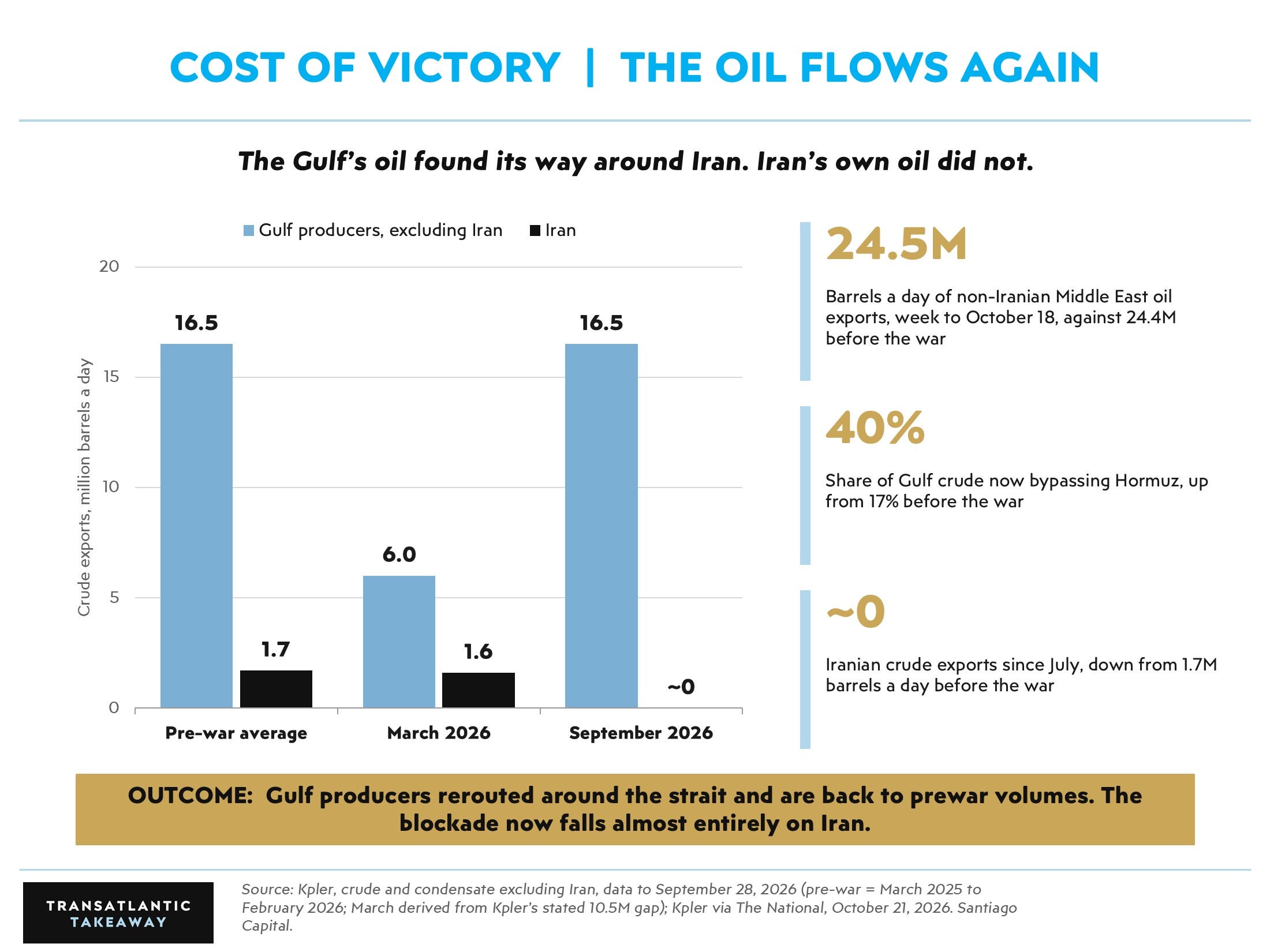
Caption: Brent's counter on the oil. The Gulf's crude found its way around the strait and back to 16.5 million barrels a day. Iran's own exports went to roughly zero. Alt: Bar chart of crude exports showing Gulf producers excluding Iran recovering from 6.0 to 16.5 million barrels a day while Iran falls from 1.7 to near zero by September 2026.
Then comes Brent's structural argument. The US has done exactly this for his entire life. Iraq, Afghanistan, Vietnam, Kosovo. It went in, it eventually came home, and it still sits near the top of the pyramid. Every hegemon in history has always been at war somewhere on the edge of empire. Rome fought for four centuries and lost plenty of battles. Losing battles on the fringe is not the coup de grace. It is the nature of the job.
His sharpest tool is the J-curve. In investing you deploy capital early, you see drawdowns, and the payoff arrives later and bigger. He argues geopolitics runs the same way. Big changes do not go smooth. The plan going sideways is not proof there was no plan. He insists there is a plan, and that it is simply too soon to read the result. He also pushes back hard on John's multipolar claim. Based on what, specifically, is the world now flat? Where is Russia more powerful than the US inside Europe? He will grant spheres of influence. He will not grant equal poles on the evidence shown.
Two men, same war, opposite reads. The place they cannot both be right is narrow, and it is worth finding.
The One Point Where Both Men Cannot Be Right
Here is where the two cases cannot both hold. It is the asymmetry of cost.
John says the US and Iran are not playing the same game. Sea power must win to justify the spend, because it draws on public opinion and distant supply lines that cannot be sustained forever. Land power at home only has to survive. So a stalemate is a loss for Washington and a win for Tehran by definition.
Brent attacks the definition itself. If a stalemate is automatically a US loss, then every US operation in seventy years was a loss, and yet the US stayed on top. He turns John's own logic on Russia. If the US failing to control the Gulf in six months proves it is a spent power, why does Russia failing to settle Ukraine on its own border in four years not prove Russia is a spent power too? John answers that land war is different in kind. It is fought for permanent control of territory, won by throwing more metal than the enemy can throw back, and Russia chose a slow meat grinder on purpose. Brent hears special pleading. One rule for the sea power, another for the land power.
That is the hinge. If cost is asymmetric the way John says, Iran's survival ends the era. If it is not, this is one more edge-of-empire war that resolves like the others.
Where It Moved and Where It Did Not
It moved, a little, and honestly. John conceded the two things that could make him wrong. He may be overestimating Iran's domestic stability. And there may be a military solution he cannot see, though he doubts it, since the US would have used it already. Brent conceded that John has very valid points and that the Suez outcome cannot be ruled out.
They converged on an endgame too. John sketched a regional deal. Iran shares Hormuz revenues with Turkey, Pakistan, and the Gulf states, the US is tossed a bone and allowed anti-piracy patrols, and the balance tilts away from Washington. Brent asked the obvious question. If the US refocuses on the Western Hemisphere as its own security strategy says, how is that a loss? John's answer was not that the destination differs. It was that the same destination could have been reached by diplomacy, without the blood and treasure. Brent's answer was that this is not how the people who run things make decisions, and that the payoff may still beat expectations.
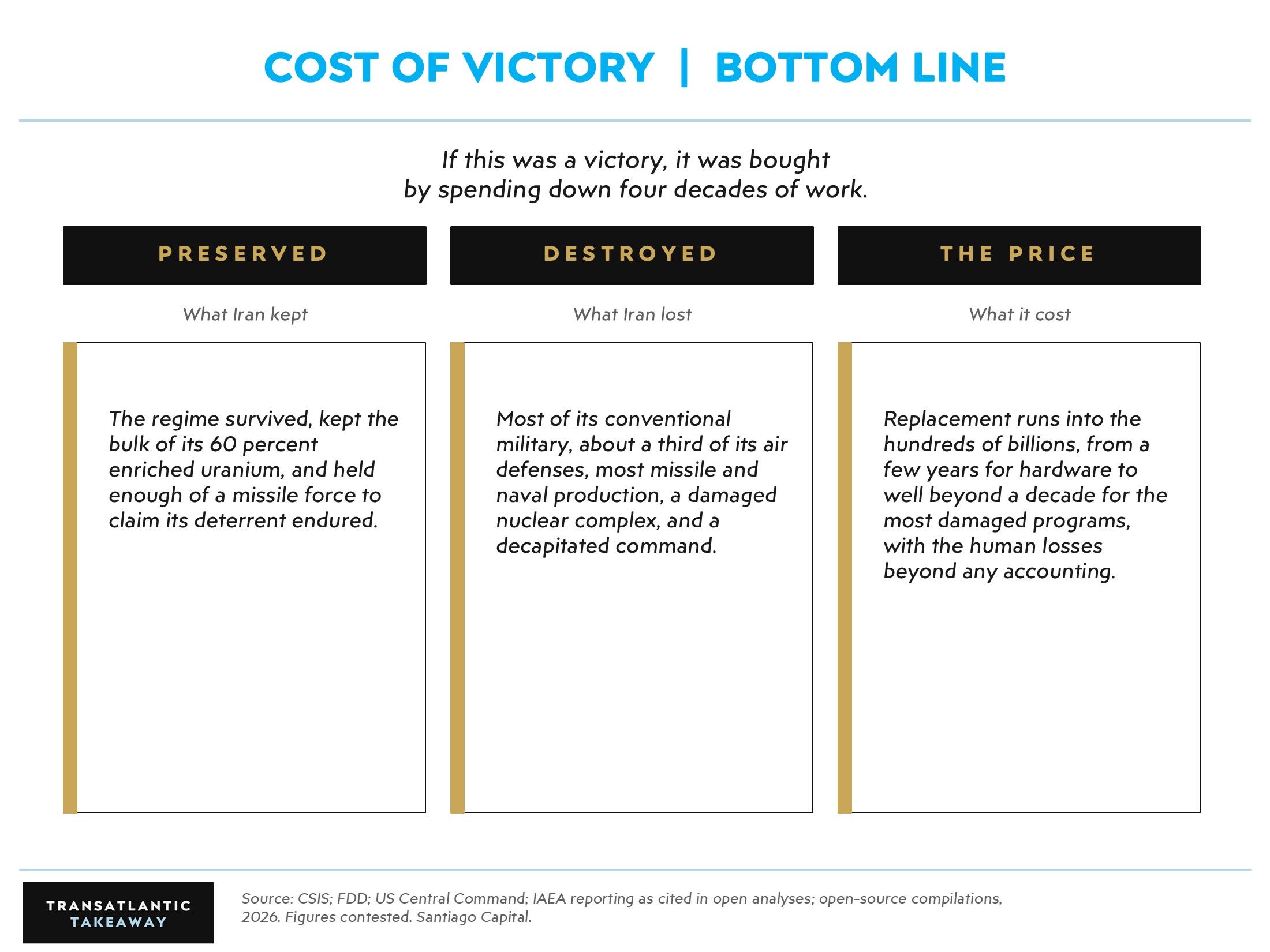
Caption: The ledger both men argued over. Iran kept its regime and most of its enriched uranium. It lost most of its conventional military and its command. The price runs into the hundreds of billions. Alt: A three-column summary headed Preserved, Destroyed, and The Price, listing what Iran kept, what it lost, and the replacement cost running into hundreds of billions.
Neither man moved on the hinge. John still reads the asymmetry as decisive. Brent still reads it as a mid-game he refuses to score.
So the question sits where it started. Is Iran the Suez moment, the day the US learns the terms are no longer its to set? Or is it the early, ugly stretch of a J-curve nobody has the right to grade yet? Both men looked at the same wreckage. One saw an ending. One saw a middle. The show, as ever, declines to break the tie.
TransAtlantic TakeAway is a free weekly debate between Brent Johnson and John Butler on the forces moving markets. Subscribe to get every episode.
Discussion about this video