

A tweet set it off. Earlier this week Brent Johnson scrolled past a post claiming that MMT had been implemented all over the world, and that we are now paying for it. He stopped. Something in it was off. Not wrong, exactly. Just not right. And he knew the one person who would take it apart properly.
So he called John Butler.
The question they put on the table is simple to ask and brutal to answer. Has de facto Modern Monetary Theory already been implemented, and if it has, what happens next?
Brent runs Santiago Capital, and he thinks in terms of how the plumbing actually works before he decides whether he likes it. He is not an MMT guy, and not strictly an Austrian either. He wants to know how a system functions so he can figure out how long it can last. John Butler, writing from London, has studied MMT closely enough to state its case fairly, and he rejects it on Austrian grounds. He trusts price signals, creative destruction, and constraints on government. Both men agreed, quickly, that we are not in pure MMT today. We are somewhere in the middle. Stephanie Kelton, John said, would call it purgatory. Stuck between the old gold-standard assumptions and a future fully free of them.

Why Brent Thinks the System Can Last Longer Than You Expect
Brent's first move was to defend MMT from the people attacking it. The tweet said governments believe they can spend without consequence. That is not what MMT says. MMT is first a description of mechanics. The prescriptions come later, bolted on by its proponents, who would almost certainly push further than what we do now.
Here is the mechanic that matters to Brent. In a free-market framing, the government borrows first, then spends. In the MMT framing, the government spends money into existence first, and borrowing comes after, as a tool to drain liquidity. Chicken and egg. Go far enough down the road and it stops mattering which came first.
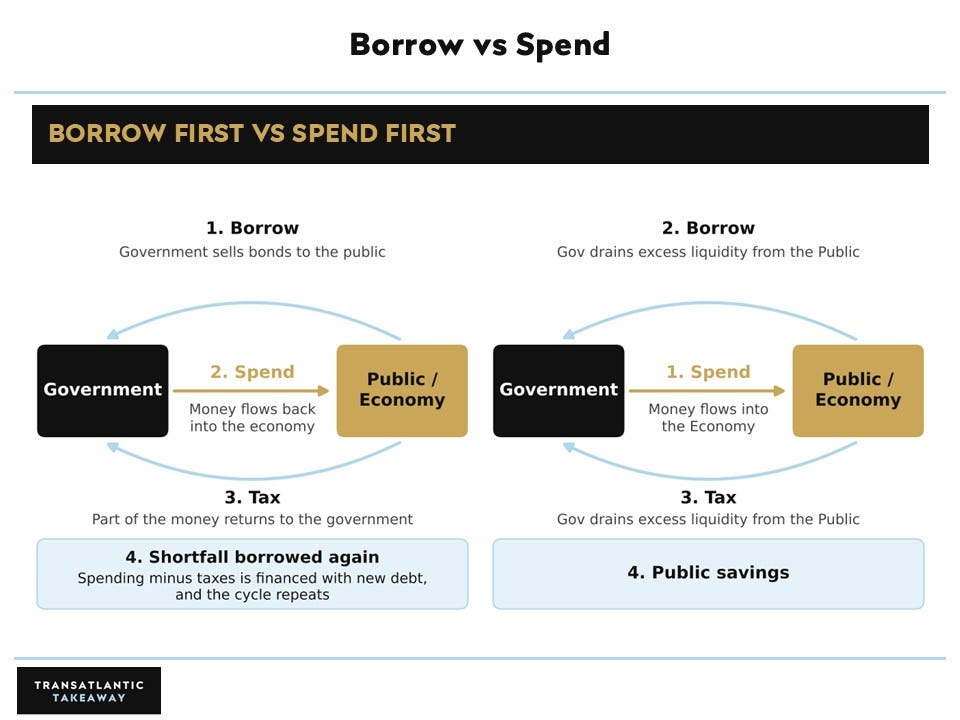
His key insight sits in the right-hand column of that chart. When the government spends money into the economy and then issues bonds to mop some of it back up, the public now holds an asset. Call it public savings. That is why Brent thinks this can run longer than the doom crowd expects. The debt is not just a burden. It is the private sector's collateral.
That leads to a claim that seems to invert everything you have been told. If you aggressively paid down the national debt, from 40 trillion toward 19 trillion, you would be sucking savings and collateral out of the private sector. That would be deflationary. It could trigger a depression. Brent is not cheering the system. He is telling you how it holds together.
Why John Thinks MMT Ends in Control Fraud
John gave MMT its due, and more. If a central bank is always willing to fund deficits at whatever rate hits the nominal GDP target, then the central bank is a charade. Get rid of it. Let the government spend money into existence directly, let it flow horizontally through the commercial banks, and cut out an unnecessary layer of bureaucracy. The people who are fuzzy on whether the Fed is public or private can stop pretending. John said plainly that he has sympathy with this. He meant it.
Then he drew the line. Remove a constraint on government power, however weak or arbitrary, and government grows at the expense of the private sector. The private sector pays for capital, makes trade-offs, and goes bankrupt when it fails, which recycles resources to better operators. Government faces none of that discipline. Only the ballot box, and who knows what happens there.
The MMT answer is that the fiscal authority raises taxes to cool an overheating economy and cuts them to free up resources. Stay one step ahead of full employment, 24-7, and it runs smoothly. John's reply was quiet and devastating. On paper, socialism works extremely well too. The question is not the mechanics. It is whether flawed individuals can run a comprehensive form of central planning without eventually gaming it. He sees the endpoint as control fraud. Unlimited power, no real check, and officials who redefine inflation when it becomes inconvenient.
The Point Where Brent and John Cannot Both Be Right
For a stretch they agreed. Milton Friedman, pressed late in life, admitted the central bank always loses to a determined government. Both men nodded. Fiscal dominance wins.
The real fracture came over paying down the debt. Brent said doing it aggressively would be deflationary. John would not sign on, not at first. His escape hatch is devaluation. The US runs a chronic current account deficit, so the realistic exit is to devalue against the rest of the world, force labor costs down, and export your way back to balance. Inflate the real value of the debt away rather than retire the nominal amount. The debt goes from 120% of GDP to a rounding error, and nobody cares anymore.
Brent pushed. If money is disappearing, how is that inflationary? They circled, and then they found the seam. Brent's scenario is literally retiring debt, shrinking the nominal pile, destroying the collateral. John's scenario never shrinks the nominal debt at all. He shrinks it relative to income through inflation. Once that was clear, they agreed on the mechanics. Aggressively paying off nominal debt is deflationary. Both men said so. They had been answering two different questions the whole time.
Where the Argument Actually Moved
John offered the cleaner exit, and it is not the slow grind. Revalue gold to 50,000 dollars, devalue the dollar, and the debt becomes serviceable. One savage wave of inflation rolls through. Then peg to gold, let interest rates fall to 2 or 3% on restored credibility, and boom. He reached for history. The post-Civil War greenback retirement. Warren Harding in 1920, slashing the budget, letting deflation run, and getting the Roaring Twenties. Argentina and Milei now.
Brent pressed on the human cost. In that reset, people holding real assets do phenomenally well. People holding dollars and retirement savings get wiped out. Why is one big shock for the majority better than a slow bleed over 30 years? John conceded the point honestly. Policymakers never want the frog to jump out of the pot. That is exactly why almost no country chooses the reset until prolonged inflation and hardship force its hand. Argentina is the exception that proves the rule.
Neither man gave ground on the thing beneath it all. Brent trusts the market to allocate. John trusts constraints to discipline power. Yet both end up expecting a structurally inflationary world. John because resources get diverted to the public sector. Brent because the system is built to keep creating collateral.
So return to the tweet that started it. Has MMT been implemented? Not purely. We are in the middle, in the purgatory, and both men think the individuals running it are the flaw no spreadsheet captures.
The way out is either a slow grind or a sudden reset. The show does not tell you which. It only tells you that you are already in the waiting room.
TransAtlantic TakeAway is a free weekly debate between Brent Johnson and John Butler on the forces moving markets. Subscribe to get every episode.

